Why Big Chocolate Undergoes Restructuring While Cocoa Farmers Get Lectures on Resilience
When large firms suffer from volatility, it becomes a strategic crisis. When farmers suffer from volatility, it is treated as part of rural life.

Last week, I asked a difficult question of one of cocoa’s favourite words: sustainability. I argued that the sustainability machinery around cocoa keeps growing even while the farmer remains exposed. More traceability, more compliance, more mapping, more climate language, more professional roles, more programmes. Yet when the chain comes under stress, the farmer still seems to be the easiest place to deposit the pain. I argued that much of what is now called sustainability is often designed first to protect market access, brand legitimacy, buyer assurance, and regulatory compliance higher up the chain, while the farmer remains visible in the data but insecure in life. That is why I asked: sustainability for whom?
This week, I want us to look at another deep imbalance in the cocoa and chocolate system. It is one that often goes unnamed because it is hidden in the language we use for different kinds of suffering. When major companies struggle, we describe their pain as a crisis. We call emergency meetings. We review the strategy. We redesign business models. We replace leadership. We discuss margins, volatility, exposure, and restructuring. This is perfectly exemplified within the 2025/2026 crop year, where price volatility was at its peak. But when cocoa farmers struggle, the language changes completely. Then we speak of resilience. We talk about adaptation. We urge patience. We recommend diversification, productivity, better agronomy, and coping strategies. One kind of pain becomes a boardroom emergency. The other becomes a personal quality.
That contrast reveals whose suffering the chain considers urgent, structural, and worthy of redesign.
Take one recent example. Reuters reported in February that Barry Callebaut, the world’s largest chocolate maker, parted ways with its chief executive after a high-level split over a proposal to separate the company’s cocoa business from its chocolate business. The disagreement reflected concern about volatility, weak returns, and how exposed the cocoa side of the business had become. That should interest anyone who cares about the politics of cocoa, not because corporate strategy is more important than farmer life, but because it shows how seriously instability is treated when it reaches the top of the chain. When volatility threatens large firms, it is not romanticised. It is not turned into a character-building exercise. It is not narrated as resilience. It becomes a strategy problem. It becomes a governance problem. It becomes a reason for structural change.
Now place that beside what is happening to farmers in Ghana and Côte d’Ivoire. Ghanaian farmers have gone unpaid for cocoa already delivered. Some have been forced to skip meals, delay school fees, and postpone farm maintenance while waiting for money already earned. Reuters reported that even after a major disbursement was announced to clear arrears, many farmers still had not been paid. (reuters.com) In Côte d’Ivoire, cocoa stocks piled up in warehouses, cooperatives struggled, and the government had to reassure farmers that excess cocoa would still be bought amid tensions over possible producer-price cuts. (reuters.com) This is life-altering pain. Yet it is rarely treated with the same institutional seriousness as the discomfort of large companies.
This is what I want us to confront. A company facing volatility is allowed to say, “This arrangement no longer works for us.” A farmer facing volatility is often expected to say, “I must endure.” A company facing falling margins can consider restructuring, divestment, product redesign, or leadership change. A farmer facing delayed payment is told to be patient. A company is granted the right to redesign the system around its pain. The farmer is often asked to adjust himself to the pain instead.
This difference tells us something fundamental about power. It tells us that not all suffering in the cocoa chain is interpreted politically. Some suffering is treated as evidence that the structure itself must change. Other suffering is treated as proof that the person at the bottom must become stronger. That is the real violence hidden inside the word resilience. It can quietly move attention away from the structure and back onto the person absorbing its failures.
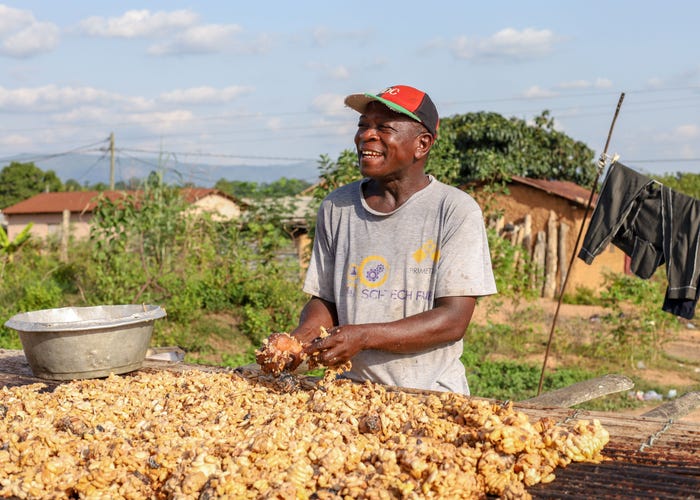
Of course, there is nothing wrong with resilience as a human quality. Farmers do endure extraordinary difficulty. Many do adapt with remarkable strength. They keep going through price swings, late payments, disease outbreaks, poor roads, labour shortages, climate shocks, school demands, family pressure, and institutional indifference. That is why you see that very big smile on their faces, regardless. But that is exactly why the word must be handled carefully. If resilience becomes the main story, it can stop us from asking why so much endurance is required in the first place. It can turn structural injustice into a compliment. It can make survival under avoidable hardship sound admirable enough that nobody feels pressure to change the design producing the hardship.
ECOM (major commodity trader) explicitly frames current conditions as a “test of resilience”, tying farmer livelihoods to the sector’s ability to adapt to volatility and climate shocks. [ecomtrading.com]
The same report emphasises “strengthening climate resilience and farmer livelihoods” as a core achievement area, embedding resilience as a positive outcome narrative. [ecomtrading.com]
ofi (Olam Food Ingredients) similarly centres the need for a “resilient… supply chain that benefits both people and the planet” and ties sustainability to building resilience among producers. [ofi.com]
Industry programmes define resilience in technical terms as farmers’ “ability to withstand, adapt to, and recover from shocks” such as price volatility and climate stress.
That is why I have become increasingly uneasy with how easily the cocoa sector praises farmer resilience. Think about what is often being praised. A farmer who has not been paid still finds a way to feed the family. A farmer whose crop is stuck still keeps the farm from collapsing. A farmer who has seen prices fall still prepares for the next season. A farmer whose children’s needs are pressing still holds on to the crop. These things are often presented as evidence of strength. And they are. But they are also evidence of abandonment. They show how much the farmer is left to carry because the structure above him has decided he can carry it.
No one says to a large chocolate company, “Your falling margins are a chance to prove your resilience.” No one tells a major processor or manufacturer, “Your current pain will build your character.” No one asks investors to admire the endurance of a firm that is struggling under commodity volatility and do nothing else. Instead, when a large firm is exposed, the system turns practical. What needs to change? What needs to be separated? What can be restructured? How do we reduce exposure? How do we restore profitability? How do we preserve the business model? The contrast could not be clearer. Farmers are given motivational language, while firms are given structural options.
This matters because it shapes how solutions are imagined. Once a farmer suffering is coded as resilience, the proposed solutions tend to focus on helping the farmer cope better rather than helping the system exploit him less. Then the answers become training, adaptation, diversification, climate-smart agriculture, farmer field schools, productivity gains, and behavioural support. Again, none of these things is necessarily bad. Some are useful. But they are very different from the kinds of responses offered to powerful firms in difficulty. Powerful firms are offered a redesign. Farmers are offered coping.
And this is not only happening in abstract discussions. We can see it in real time. Reuters reported that the plunge in cocoa prices after earlier highs was partly linked to weaker demand, as chocolate makers reduced bar sizes, increased non-cocoa additives, and substituted cocoa butter with alternative fats. (reuters.com) That is a form of restructuring. It is the chain changing itself when costs become uncomfortable. Companies are not sitting still under pain. They are redesigning products, protecting margins, and altering strategies. Yet when the pain reaches the farmer, the farmer is not usually offered a redesigned chain in return. He is offered a speech about endurance.
This is also why I think the current cocoa crisis has made the moral hierarchy of the value chain unusually visible. It is showing us whose pain counts as a signal for institutional action and whose pain counts as the normal background noise of production. When cocoa becomes expensive for large firms, headlines appear quickly. Analysts discuss demand destruction. Strategies are reviewed. Major decisions are made. But when farmers go hungry because payment has not come, or when cocoa sits unsold while school fees remain unpaid, the suffering is treated as sad but somehow unsurprising. That difference is not accidental as it reflects the fact that some actors are positioned as essential to the future of the chain in ways others are not, even when the entire chain rests on the labour of the farmer.
This is why I keep saying that cocoa is not just about value distribution. It is also about dignity distribution. Whose difficulty is considered unacceptable? Whose exposure is treated as too much? Whose pain prompts redesign, and whose pain prompts advice? If we ask those questions honestly, the answers are hard to avoid.
There is another layer to this. Resilience language can also be politically useful because it individualises what should be social and structural. If farmers are resilient, then the burden remains close to the farm. The conversation stays local. It becomes about household coping, community adaptation, and personal strength. But the moment we stop calling it resilience and start calling it structural overexposure, the conversation changes. Then we must talk about buying systems, state power, financing models, firm margins, product design, global commodity politics, and the architecture of risk in the chain. That shift matters. Because systems prefer suffering that stays small enough to admire rather than large enough to reorganise power around.